
AI platforms
Apache MXNet
A flexible and efficient deep learning framework with hybrid front-end and multi
What is Apache MXNet?
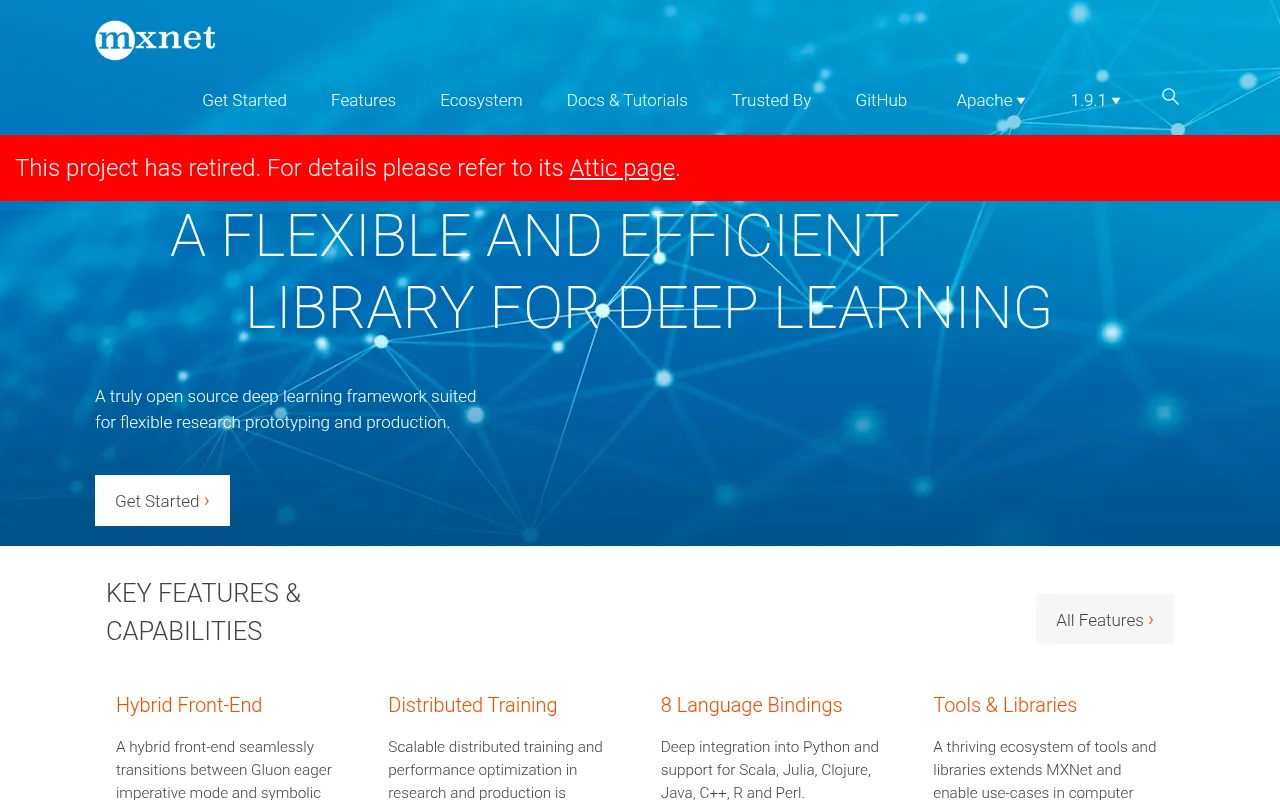
Apache MXNet is a flexible and efficient library for deep learning, designed to provide a truly open source solution for both flexible research prototyping and production.It combines the flexibility of imperative programming with the speed of symbolic execution, allowing developers to optimize model performance at different stages.
The framework boasts a robust ecosystem, including GluonCV for computer vision, GluonNLP for natural language processing, and GluonTS for time series modeling.Additionally, MXNet offers a rich toolchain and documentation resources, such as the interactive deep learning book D2L.ai, helping engineers and researchers rapidly prototype ideas.
Please note that according to official information, this project has retired.For details, please refer to its Attic page.While new versions are no longer actively developed, its architectural design and existing resources remain valuable references for understanding deep learning frameworks.
Key features
- Hybrid Front-EndSeamlessly transitions between Gluon eager imperative mode and symbolic mode to provide both flexibility and speed.
- Distributed TraiEnables scalable distributed training and performance optimization via dual Parameter Server and Horovod support.
- 8 Language BindiDeep integration into Python and support for Scala, Julia, Clojure, Java, C++, R, and Perl.
- Rich EcosystemIncludes tools like GluonCV, GluonNLP, and GluonTS, covering computer vision, NLP, and time series.
- Educational ResoProvides interactive deep learning books like D2L.ai, used at universities such as Berkeley.
How to use it
- Visit the Apache MXNet official website or GitHub repository to access historical version code.
- Check the 'Get Started' guide in the official documentation for installation and basic usage.
- Build models using the Gluon interface, choosing between imperative or symbolic execution modes as needed.
- Accelerate development in specific domains using ecosystem tools like GluonCV or GluonNLP.
- Participate in community discussions or check known issues via Jira Tracker (note that the project has retired).
Where it fits
- Academic ResearcPrototype and experiment with deep learning algorithms using its flexible Gluon interface.
- Computer VisionDevelop vision tasks like object detection and pose estimation using the GluonCV toolkit.
- Natural LanguageRapidly build and test state-of-the-art NLP models with GluonNLP.
- Time Series ForeApply GluonTS for probabilistic time series modeling based on deep learning.
Pricing and free quota
Apache MXNet is open source software licensed under the Apache License 2.0, free to use.Pricing follows the official site.
Who it is for
- Deep Learning Researchers
- AI Algorithm Engineers
- Data Scientists
- University Students and Faculty
FAQ
Is Apache MXNet still maintained?
According to the official site, the project has retired.Please refer to its Attic page for details.
Which programming languages does MXNet support?
It features deep integration with Python and supports Scala, Julia, Clojure, Java, C++, R, and Perl, totaling 8 languages.
What is the Hybrid Front-End?
The Hybrid Front-End allows users to seamlessly switch between Gluon's imperative mode and symbolic mode, gaining both development flexibility and execution efficiency.
How can I learn to use MXNet?
You can refer to the officially recommended D2L.ai interactive book, as well as tutorials and examples in the official documentation.