
Models & resources
DeepSpeed
Microsoft's open-source deep learning optimization library that breaks memory ba
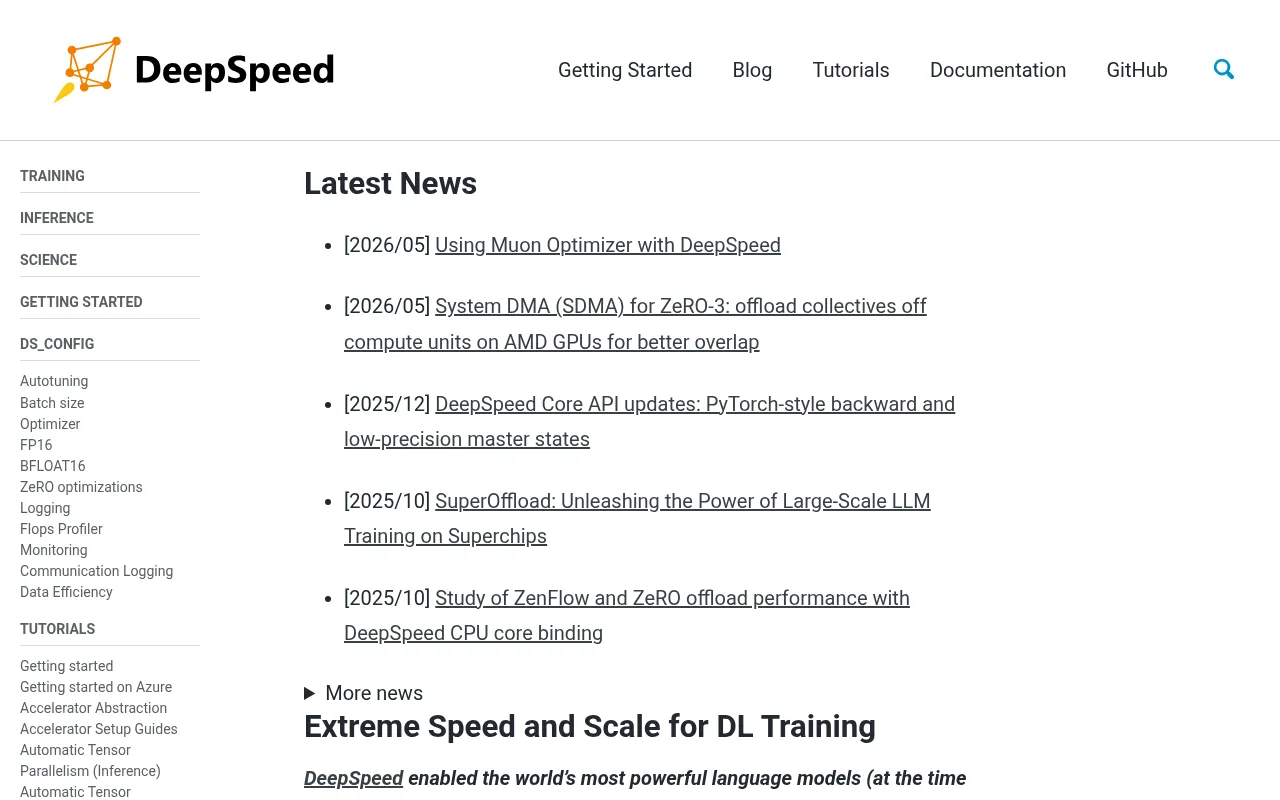
What is DeepSpeed?
DeepSpeed is a deep learning optimization library developed by Microsoft to make distributed training easy, efficient, and effective.As a core part of Microsoft’s AI at Scale initiative, DeepSpeed redefines the boundaries of large-scale deep learning through system innovations, supporting model training from billions to trillions of parameters.
The library integrates key technologies such as ZeRO (Zero Redundancy Optimizer), 3D Parallelism, DeepSpeed-MoE (Mixture of Experts), and ZeRO-Infinity.These innovations significantly reduce memory usage and improve communication efficiency.DeepSpeed has been used to train world-class large language models like MT-530B, BLOOM (176B), and Jurassic-1 (178B), and seamlessly integrates with popular frameworks including Hugging Face Transformers, PyTorch Lightning, and MosaicML.
Beyond training optimization, DeepSpeed offers robust inference acceleration features, including automatic tensor parallelism and quantization techniques like ZeroQuant, ensuring high performance during deployment.Researchers and engineers can leverage DeepSpeed to scale model sizes and boost training speeds on existing hardware infrastructure.
Key features
- ZeRO Memory OptiBreaks the GPU memory wall by partitioning model states across devices using Zero Redundancy Optimizer technology, enabling extreme-scale model training.
- 3D ParallelismCombines data, pipeline, and tensor parallelism to provide comprehensive distributed training strategies that maximize cluster compute efficiency.
- DeepSpeed-MoEAdvanced Mixture of Experts implementation that scales model capacity while maintaining efficient training and inference performance.
- Efficient InfereSupports automatic tensor parallelism and model quantization, delivering unprecedented inference speed and throughput for Transformer models.
- Broad FrameworkNative support for Hugging Face Transformers, Accelerate, Lightning, and MosaicML, lowering the barrier to entry.
- Communication OpIncludes communication-efficient algorithms like 1-bit Adam/LAMB to reduce network bandwidth pressure in large-scale distributed training.
How to use it
- 1.Install DeepSpeed: Install via pip install deepspeed or build from source on GitHub.
- 2.Prepare Configuration: Create a ds_config.json file to define ZeRO stages, batch sizes, and optimizer settings.
- 3.Modify Training Script: Use deepspeed.initialize() to set up the model and optimizer, replacing the standard PyTorch training loop.
- 4.Launch Training: Start the distributed training job using the deepspeed CLI, specifying the hostfile and number of GPUs.
- 5.Monitor and Tune: Use the built-in Flops Profiler and logging features to monitor performance and adjust parallelism strategies as needed.
Where it fits
- Trillion-ParametTraining ultra-large foundation models like BLOOM or MT-530B, overcoming single-GPU memory limitations.
- Efficient Fine-tInstruction tuning or domain adaptation of LLMs on limited resources, leveraging ZeRO-Offload to save memory.
- High-ThroughputDeploying large Transformer models with reduced latency and increased concurrency via automatic tensor parallelism and quantization.
Pricing and free quota
DeepSpeed is an open-source project by Microsoft and is free to use.Pricing follows the official site.
Who it is for
- AI Researchers
- LLM Training Engineers
- MLOps Developers
- HPC Specialists
FAQ
Which deep learning frameworks does DeepSpeed support?
DeepSpeed is primarily based on PyTorch and is deeply integrated with popular frameworks like Hugging Face Transformers, Accelerate, PyTorch Lightning, and MosaicML.
What is ZeRO?
ZeRO (Zero Redundancy Optimizer) is DeepSpeed's core technology that partitions model states (weights, gradients, optimizer states) across devices to eliminate memory redundancy in data parallelism, enabling the training of larger models.
How many GPUs do I need to use DeepSpeed?
DeepSpeed can be used in single-GPU or multi-GPU environments.While its advantages are most pronounced in distributed multi-GPU training, technologies like ZeRO-Offload also help train larger models on resource-constrained single cards or small clusters.