
AI platforms
DL4J
Eclipse Deeplearning4j (DL4J) is an open-source, distributed deep learning framework designed specifically for the JVM.
What is DL4J?
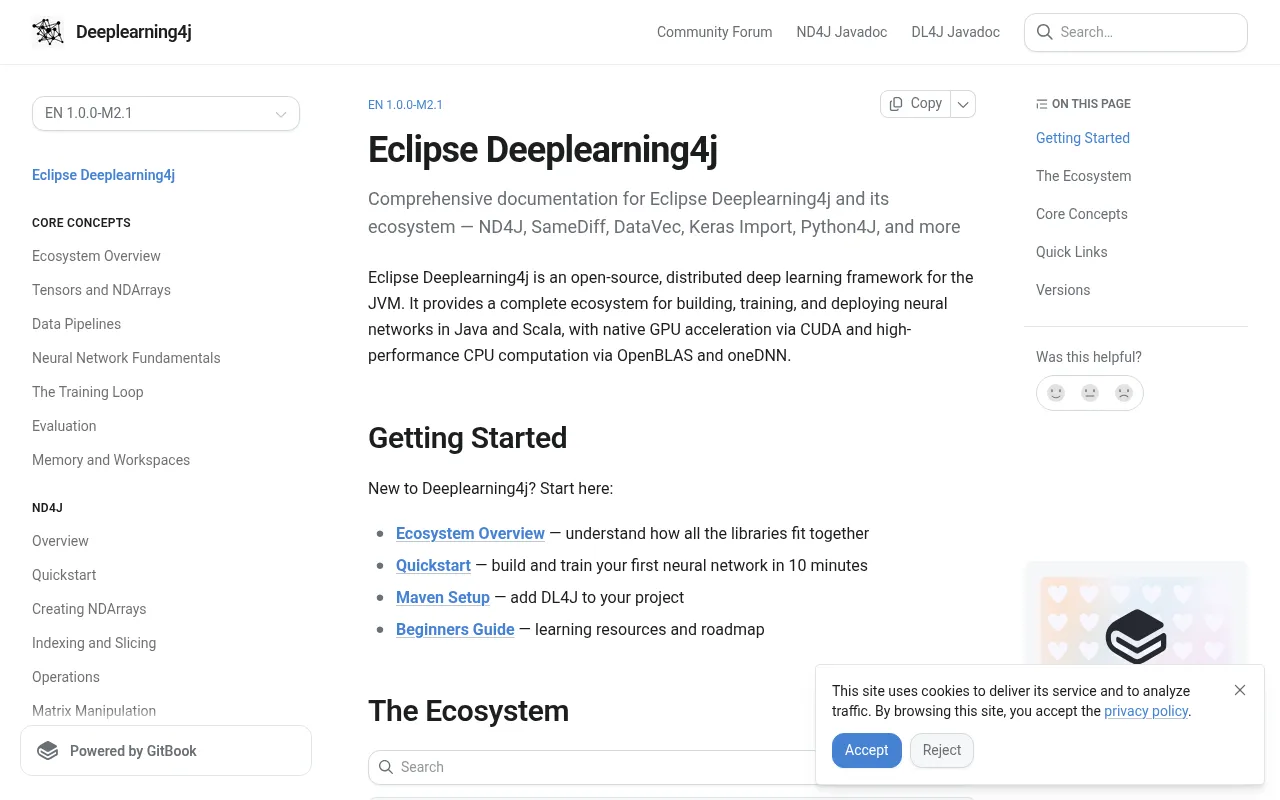
Eclipse Deeplearning4j (DL4J) is an open-source, distributed deep learning framework designed specifically for the JVM.It enables developers to build, train, and deploy neural networks directly within Java and Scala environments, leveraging native GPU acceleration via CUDA or high-performance CPU computation through OpenBLAS and oneDNN.
More than just a single library, DL4J offers a comprehensive ecosystem including ND4J for N-dimensional array computing (NumPy for Java), SameDiff for automatic differentiation, DataVec for data ETL, and Arbiter for hyperparameter optimization.It also supports importing models from Keras, TensorFlow, and ONNX, and provides Python4J for seamless Java-Python interoperability.
Key features
- Native JVM SuppoDesigned specifically for Java and Scala, allowing seamless integration into existing enterprise JVM stacks without cross-language overhead.
- Hardware AccelerProvides native GPU acceleration via CUDA and supports high-performance CPU computation using OpenBLAS and oneDNN.
- Comprehensive EcIncludes core components like ND4J (numerical computing), SameDiff (automatic differentiation), DataVec (data processing), and Arbiter (hyperparameter optimization).
- Model Import ComSupports importing pre-trained models from Keras, TensorFlow, ONNX, and GGML/GGUF formats, facilitating transfer learning.
- Distributed TraiEnables distributed training on Spark clusters, making it suitable for handling large-scale datasets and enterprise applications.
- Python InteroperEmbeds CPython via Python4J, allowing direct calls to Python code and NumPy from within Java applications.
How to use it
- 1.Environment Setup: Ensure you have JDK and a build tool like Maven or Gradle installed.
- 2.Dependency Configuration: Add DL4J and ND4J backend dependencies (such as cuda or cpu) to your pom.xml or build.gradle.
- 3.Data Preprocessing: Use DataVec to load data, define schemas, and perform necessary transformations and normalization.
- 4.Model Building: Define neural network layers, activations, and loss functions using the DL4J API, or define computation graphs with SameDiff.
- 5.Training & Evaluation: Configure training listeners, execute the training loop, and monitor model performance using built-in evaluation metrics.
- 6.Deployment & Inference: Serialize and save the model to a file, then load it in your production environment for inference.
Where it fits
- Enterprise JavaEmbed deep learning capabilities directly into existing Java backend systems, such as fraud detection or recommendation engines, avoiding microservice complexity.
- Big Data PipelinCombine with Apache Spark for distributed data preprocessing and model training to handle massive structured or unstructured datasets.
- Legacy Model MigImport existing Keras or TensorFlow models into the JVM environment, leveraging Java's stability and performance for production deployment.
Pricing and free quota
Eclipse Deeplearning4j is open-source software and free to use.Pricing follows the official site.
Who it is for
- Java/Scala Backend Engineers
- Big Data Engineers
- Enterprise AI Application Developers
- Machine Learning Researchers
FAQ
Which programming languages does DL4J support?
It primarily supports Java and Scala.Through the Python4J component, you can also call Python code from Java.
Do I need a GPU to run DL4J?
No.DL4J supports CPU backends (OpenBLAS/oneDNN), but using a CUDA GPU can significantly accelerate the training process.
Can I import models trained in other frameworks?
Yes.DL4J supports importing models from Keras, TensorFlow, ONNX, and GGML/GGUF.
How does DL4J work with Apache Spark?
DL4J provides distributed training capabilities, allowing parallel data processing and model training on Spark clusters, ideal for large-scale data scenarios.