
AI platforms
Keras
Keras is a deep learning library with pluggable backends, designed to give machine learning developers maximum flexibility.
What is Keras?
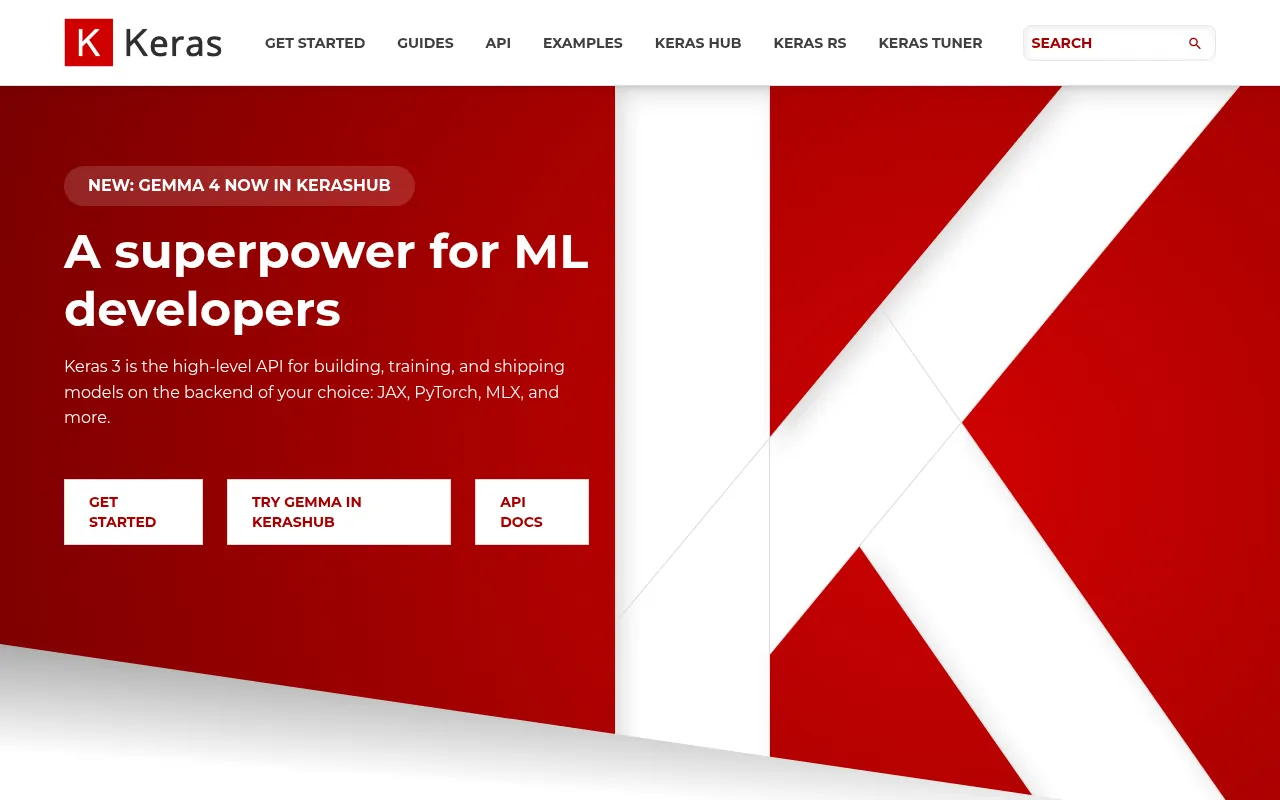
Keras is a deep learning library with pluggable backends, designed to give machine learning developers maximum flexibility.With Keras 3, you can build, train, and ship models using a unified high-level API while choosing your preferred execution engine: JAX, PyTorch, TensorFlow, or MLX.This architecture allows you to leverage the strengths of each ecosystem and scale seamlessly from laptops to TPUs.
Beyond the core framework, Keras offers extensions like KerasHub, which integrates advanced pretrained models such as Gemma 4, Qwen, and Mistral for tasks ranging from text generation to image synthesis.Whether you are working on computer vision, NLP, or generative AI, Keras provides a consistent and concise interface to help you turn ideas into production-ready applications quickly.
Key features
- Multi-Backend SuRun the same code on JAX, PyTorch, TensorFlow, and MLX without rewriting model logic.
- KerasHub PretraiAccess frontier open-weight models like Gemma 4, Qwen, GPT-OSS, and Mistral for inference and fine-tuning.
- Flexible ModelinSupport for Functional API, Sequential models, and high customization via subclassing Layers and Models.
- End-to-End WorkfBuilt-in tools for data loading, model compilation, training loops (model.fit), and evaluation simplify development.
- Industry-TrustUsed by CERN, NASA, NIH, and Waymo for scientific research and critical missions like self-driving vehicles.
- Rich Code ExamplDetailed guides and runnable code for computer vision, NLP, and generative deep learning tasks.
How to use it
- Install Keras and your chosen backend (e.g., pip install keras jax or pip install keras torch).
- Define your model architecture using keras.Input and layers, or load a pretrained model from KerasHub.
- Configure the optimizer, loss function, and metrics using model.compile().
- Prepare your dataset and start the training process by calling model.fit().
- Evaluate performance with model.evaluate() or perform inference using model.predict().
- Save model weights or the entire model for later deployment or sharing.
Where it fits
- Cross-FrameworkEasily migrate existing TensorFlow models to PyTorch or JAX environments to leverage specific hardware acceleration.
- LLM ApplicationsQuickly integrate Gemma or Qwen models via KerasHub to build chatbots or text analysis tools.
- Research & ExperRapidly prototype new neural network architectures and conduct large-scale experiments in academic and scientific settings.
Pricing and free quota
Keras is open-source software and free to use.Pricing follows the official site.
Who it is for
- Machine Learning Engineers
- Data Scientists
- AI Researchers
- Software Developers
FAQ
Which backends does Keras 3 support?
Keras 3 supports JAX, TensorFlow, PyTorch, and MLX as backends, allowing you to choose one at runtime.
What is KerasHub?
KerasHub is a library providing Keras 3 implementations of popular model architectures paired with pretrained checkpoints from Kaggle Models.
Can I use Keras on TPUs?
Yes, Keras is designed to scale from laptops to TPUs, depending on the support of the selected backend.
Is Keras free?
Yes, Keras is an open-source project that is free to use and contribute to.