
AI platforms
NLTK
NLTK (Natural Language Toolkit) is a leading platform for building Python programs to work with human language data.
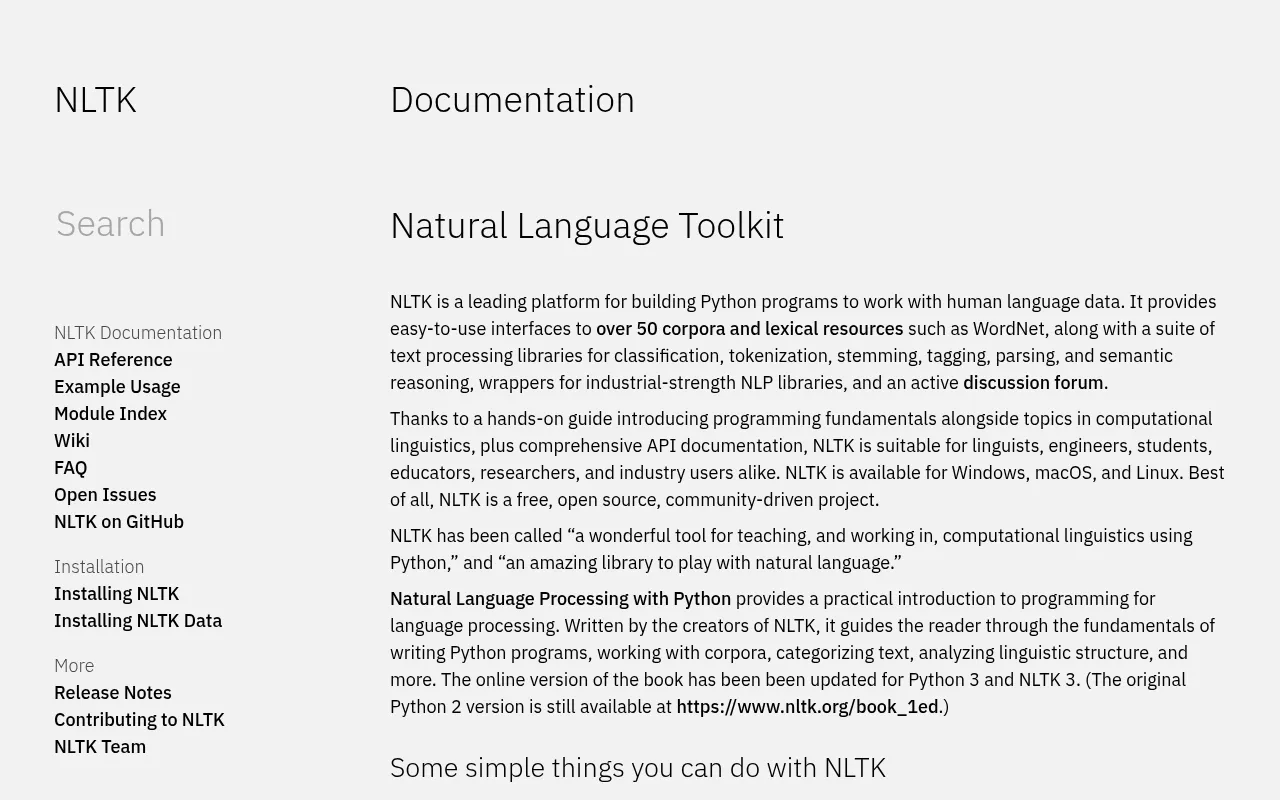
What is NLTK?
NLTK (Natural Language Toolkit) is a leading platform for building Python programs to work with human language data.It provides easy-to-use interfaces to over 50 corpora and lexical resources such as WordNet, along with a suite of text processing libraries for classification, tokenization, stemming, tagging, parsing, and semantic reasoning.
As a free, open-source, community-driven project, NLTK offers wrappers for industrial-strength NLP libraries and combines programming fundamentals with computational linguistics topics through hands-on guides.It has been described as “a wonderful tool for teaching, and working in, computational linguistics using Python,” making it suitable for linguists, engineers, students, educators, and researchers.
Available for Windows, macOS, and Linux, NLTK features comprehensive API documentation.The official book “Natural Language Processing with Python,” written by the creators of NLTK, provides a practical introduction to writing Python programs, working with corpora, categorizing text, and analyzing linguistic structure.
Key features
- Extensive CorpusProvides easy-to-use interfaces to over 50 corpora and lexical resources, including WordNet, for quick access to language data.
- Comprehensive TeIncludes a suite of libraries for classification, tokenization, stemming, tagging, parsing, and semantic reasoning.
- Industrial-StrenOffers wrappers for industrial-strength NLP libraries, allowing seamless integration of high-performance tools within Python.
- Cross-Platform CFully supports Windows, macOS, and Linux, ensuring consistent development experiences across different operating systems.
- Education & ReseFeatures hands-on guides and comprehensive API documentation, making it ideal for teaching and academic research in computational linguistics.
- Open Source CommA free, community-driven project with an active discussion forum and continuous contributions from developers worldwide.
How to use it
- 1.Ensure Python is installed on your system.
- 2.Install NLTK using pip: pip install nltk.
- 3.Start the Python interpreter, import the nltk module, and run nltk.download() to fetch the required data packages.
- 4.Refer to the official documentation or the book “Natural Language Processing with Python” to start coding.
- 5.Experiment with basic text processing using functions like nltk.word_tokenize() or nltk.pos_tag().
Where it fits
- Computational LiTeachers and students use NLTK for teaching and practicing basic NLP tasks like POS tagging and parse tree visualization.
- Academic ResearcResearchers leverage its rich corpora and algorithm libraries to quickly validate NLP hypotheses and models.
- Text PreprocessiDevelopers use NLTK for tokenization, stop-word removal, and lemmatization to prepare data for downstream machine learning models.
Pricing and free quota
Pricing and any free quota follow the official site.
Who it is for
- Computational Linguistics Students
- NLP Researchers
- Python Developers
- Educators
FAQ
Which operating systems does NLTK support?
NLTK is available for Windows, macOS, and Linux.
How do I get the NLTK corpus data?
After installing NLTK, you can run nltk.download() in Python to download the required corpora and model data.
Is NLTK suitable for production environments?
While NLTK is excellent for teaching and prototyping, for high-performance production environments, it is often recommended to use its industrial-strength library wrappers or other specialized optimized tools.
Are there recommended learning resources?
The official recommendation is the book “Natural Language Processing with Python” written by the creators of NLTK, along with the detailed API documentation on the official website.