
Detection & evals
PubMedQA
PubMedQA is a specialized benchmark dataset designed for biomedical research question answering.
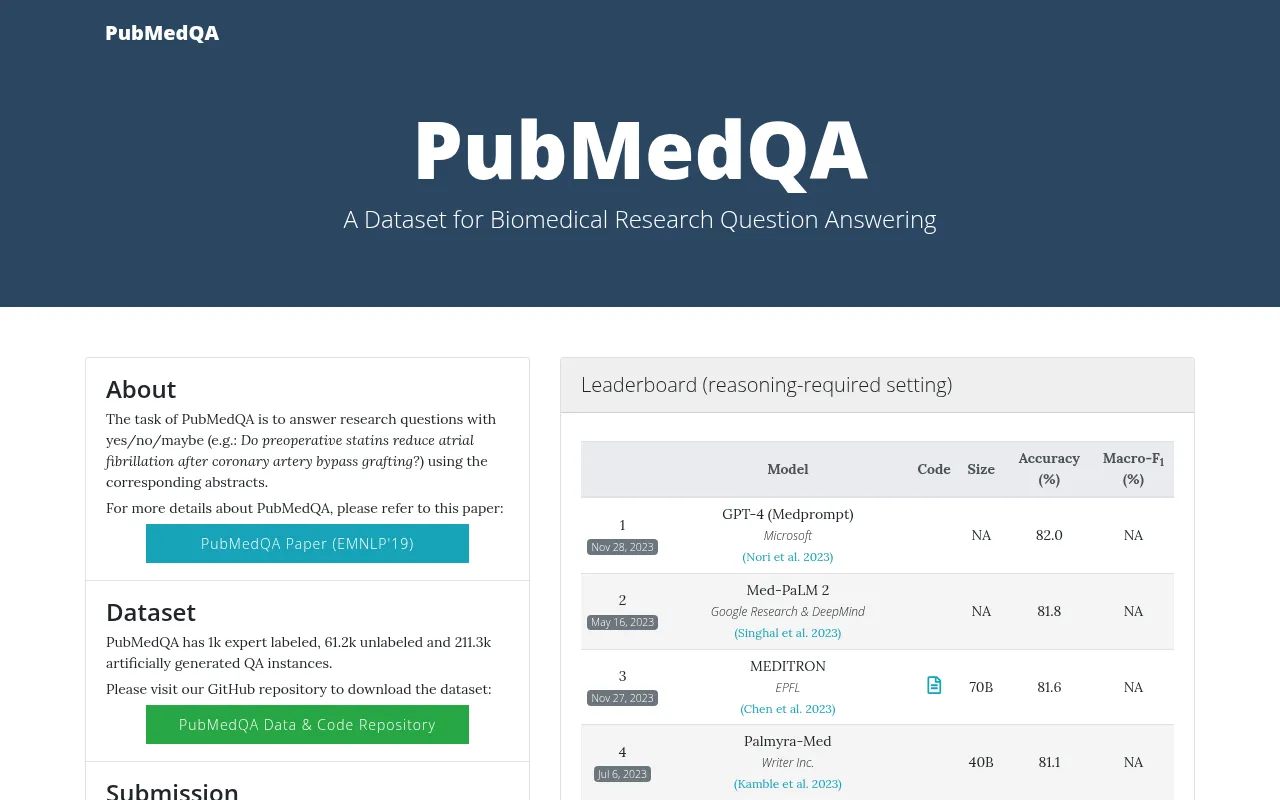
What is PubMedQA?
PubMedQA is a specialized benchmark dataset designed for biomedical research question answering.Its core task requires models to answer research questions with 'yes', 'no', or 'maybe' based solely on the corresponding PubMed abstracts, testing their ability to perform logical reasoning and fact verification without full-text access.
Introduced by Qiao Jin et al.and published at EMNLP 2019, the dataset comprises 1,000 expert-labeled instances, 61,200 unlabeled examples, and 211,300 artificially generated QA pairs.This structure provides robust resources for training and evaluating natural language processing models in the medical domain.
The official website hosts a dynamic leaderboard that tracks the performance of various state-of-the-art models, including GPT-4 (Medprompt), Med-PaLM 2, MEDITRON, and human experts.It serves as a critical reference for measuring the reasoning capabilities of biomedical AI systems.
Key features
- Expert-Labeled DIncludes 1,000 high-quality QA instances annotated by domain experts, ensuring a reliable evaluation benchmark.
- Large-Scale CorpProvides 61,200 unlabeled instances and 211,300 artificially generated QA pairs, supporting large-scale pre-training and semi-supervised learning.
- Tri-class TaskFocuses on classifying research questions into 'yes', 'no', or 'maybe', simulating real-world scientific hypothesis verification.
- Authoritative LeReal-time tracking of accuracy comparisons among state-of-the-art models (e.g., GPT-4, Med-PaLM 2) and human experts in the reasoning-required setting.
- Open Source & ReData and code are hosted on a GitHub repository, allowing researchers to easily download the dataset and submit their model results.
How to use it
- Visit the PubMedQA official website to understand the dataset background and task definition.
- Go to the GitHub repository to download the PubMedQA dataset and associated code.
- Use the provided expert-labeled data to train or fine-tune your model.
- Run your model on the test set to generate yes/no/maybe predictions.
- Submit your model results following the instructions in the GitHub repository to participate in the leaderboard.
- Cite the relevant EMNLP 2019 paper to adhere to academic standards.
Where it fits
- Medical AI ModelUsed to assess the logical reasoning and factual judgment capabilities of large language models in the biomedical field.
- Research AssistaHelps developers build intelligent systems capable of automatically filtering and verifying conclusions from medical literature.
- NLP ResearchServes as a standard benchmark for Question Answering (QA) and Natural Language Inference (NLI) tasks.
Pricing and free quota
Pricing and any free quota follow the official site.
Who it is for
- Biomedical NLP Researchers
- AI Model Developers
- Medical Data Scientists
- Computational Linguistics Students
FAQ
What is the main task of PubMedQA?
The main task is to answer research questions based on PubMed abstracts, with answer options being 'yes', 'no', or 'maybe'.
How can I access the dataset?
You can download the PubMedQA data and code from the official GitHub repository.
Who maintains the leaderboard?
The leaderboard is maintained by Qiao Jin and is updated regularly with results from new models.
How do human experts perform?
According to the data released with the dataset, human experts achieved an accuracy of 78.0% on this task.