
AI coding
Warp
Define software factories as code to orchestrate autonomous coding agents across
What is Warp?
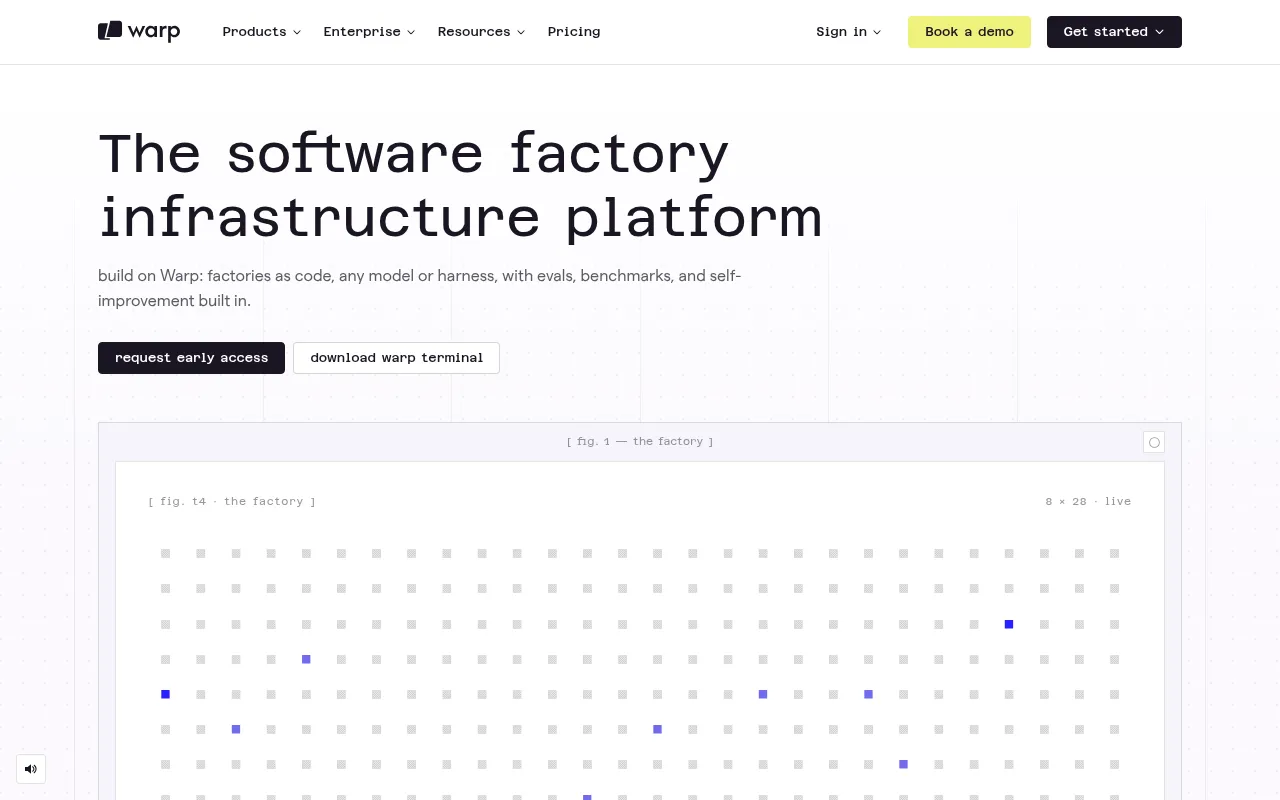
Warp is an open infrastructure platform for cloud software factories, designed to help teams move beyond traditional CI/CD and automate the entire software development lifecycle (SDLC).It enables users to define and optimize development workflows through 'Factories-as-code,' with built-in evals, benchmarks, and self-improvement loops.
At its core, Warp Factories allows teams to run fleets of coding agents.Through YAML configuration, organizations can centrally manage repository access, secrets, MCP server connections, and cloud provider permissions.Warp supports any MCP-compatible coding agent (such as Claude Code, Codex, etc.) and various models, ensuring enterprises can maintain governance and security while flexibly choosing the best tools.
Beyond robust backend orchestration, Warp offers a modern terminal specifically designed for working with agents.Developers can monitor, steer, and hand off agent runs via web, mobile, or IDE.Warp emphasizes data sovereignty, supporting self-hosting or deployment within your own VPC to ensure you retain full ownership of the data your factory produces.
Key features
- Factories as CodVersion-controlled definition of repositories, agents, models, permissions, and checkpoints via YAML, enabling measurable and optimizable factory configurations.
- Full SDLC AutomaGoes beyond code generation to handle complete workflows, from Slack/Linear task triggers and crash investigation to code review and prototyping.
- Built-in Evals &Every run is scored; observer agents automatically adjust factory configurations based on benchmark results to continuously optimize cost and performance.
- Extensive IntegrNative support for work sources like Slack, Linear, and Jira, with MCP server connections to internal services or third-party tools like Sentry.
- Flexible Model &Vendor-agnostic architecture supporting any frontier or open-weight models, and any MCP-compatible coding agents.
- Enterprise SecurCentrally configured agent access, encrypted secret management, and data control via self-hosting or private VPC deployment options.
How to use it
- 1.Download Warp Terminal or request early access to Warp Factories.
- 2.Create a factory.yaml file to define your software factory's name, alias, and associated code repositories.
- 3.Configure Secrets and MCP Servers to provide agents with secure credentials for accessing internal tools and cloud services.
- 4.Set up Integrations (such as Slack or Linear) so workflows can be automatically triggered from existing collaboration tools.
- 5.Define Agents and Automations, specifying how the Foreman agent handles tasks and when to execute specific workflows.
- 6.Deploy the factory and monitor runs, using built-in Benchmarks and Scorers to continuously optimize agent performance.
Where it fits
- Automated IncideReceive fatal crash reports from Sentry via webhooks, automatically triggering agents to investigate causes and generate fix proposals.
- Intelligent CodeConfigure specialized review agents to automatically check code quality, test coverage, and compliance before PRs are merged.
- Task-Driven DeveSync task cards from Linear or Jira; agents automatically pull code, implement features, and submit PRs, with status updates flowing back to the task system.
Pricing and free quota
Warp Terminal offers a free tier including core terminal features and limited cloud agent access; additional agent usage is pay-as-you-go.Enterprise pricing for Warp Factories is available upon request from the official site.
Who it is for
- Engineering teams seeking SDLC automation
- Enterprises requiring centralized AI agent governance
- Tech leaders aiming to optimize cloud development costs
- Developers using modern terminals for efficiency
FAQ
Which AI models does Warp support?
Warp supports any frontier or open-weight models, allowing users to flexibly choose per pipeline stage without vendor lock-in.
What is 'Factories as Code'?
It is a method of defining software factory configurations—including repositories, agents, and permissions—as code (YAML), making them version-controlled, measurable, and easy to optimize.
Is my data secure?
Yes, Warp supports self-hosting or deployment in your own VPC, ensuring you own and store all data produced by your factory, with zero-retention options available.
What is the difference between Warp Terminal and Warp Factories?
Warp Terminal is a modern terminal application for developers, while Warp Factories is an infrastructure platform for orchestrating and managing fleets of coding agents across the SDLC.