
AI platforms
MLX
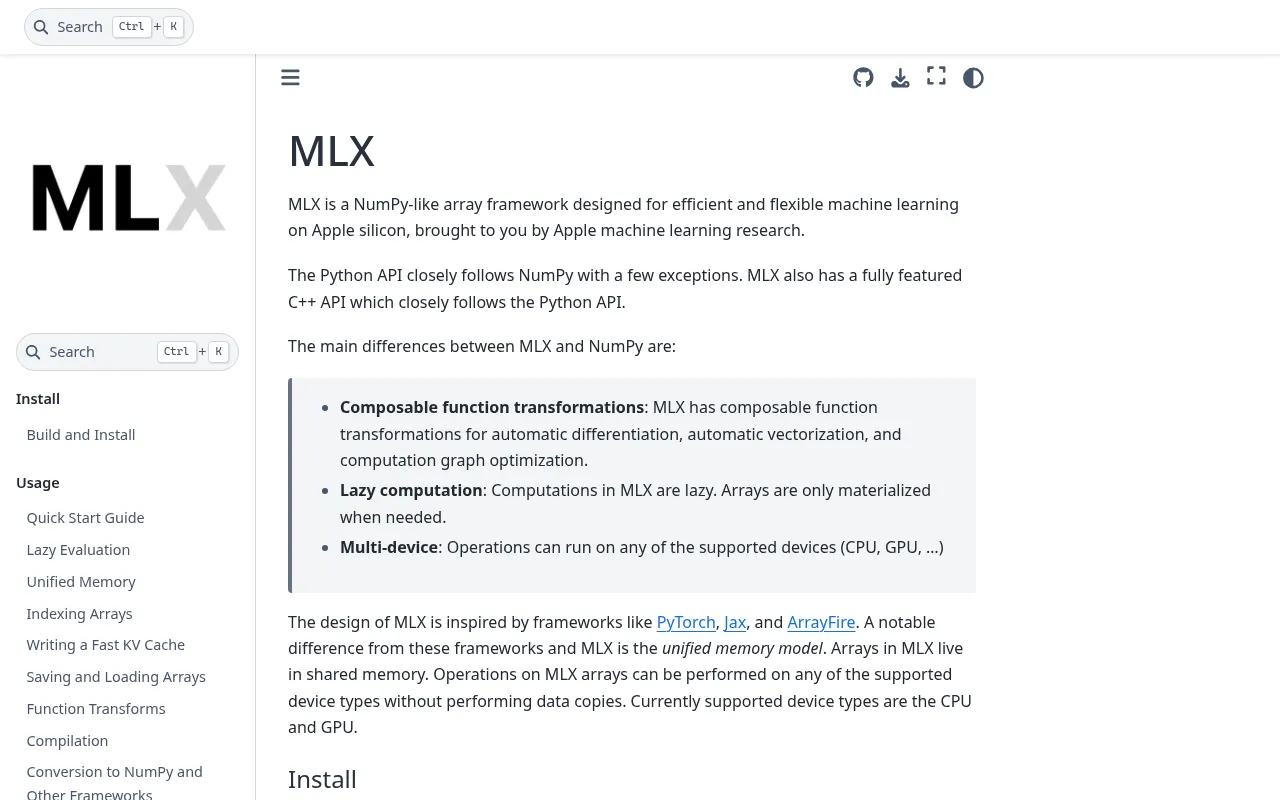
MLX is an array framework developed by Apple's Machine Learning Research team, designed to streamline machine learning development on Apple silicon (such as the M-series chips).
What is MLX?
MLX is an array framework developed by Apple's Machine Learning Research team, designed to streamline machine learning development on Apple silicon (such as the M-series chips).It features a NumPy-like API that lowers the barrier to entry, while delivering high performance through lazy evaluation and computational graph optimization.
The core advantage of MLX lies in its unified memory architecture, which allows data to be accessed by all processor cores without copying between CPU and GPU.This not only reduces memory overhead but also significantly accelerates large-scale model training and inference.MLX supports dynamic graph construction, giving developers the flexibility to alter computation flows on the fly, making it ideal for research and rapid prototyping.
Beyond basic tensor operations, MLX provides automatic differentiation, compilation optimizations, and advanced primitives tailored for Transformer architectures, such as fast attention mechanisms and RoPE.Whether experimenting with linear regression or deploying large language models, MLX offers macOS users an efficient, native, and extensible development environment.
Key features
- Unified Memory AData is stored in shared memory, accessible directly by the CPU, GPU, and Neural Engine, eliminating latency and overhead from data copying.
- NumPy-like APIOffers a familiar and intuitive interface with support for multi-dimensional array operations, broadcasting, and a rich set of mathematical functions, easing migration for existing Python users.
- Lazy EvaluationUses lazy evaluation to build computational graphs and optimizes runtime efficiency through just-in-time compilation via mlx.core.compile.
- Automatic DifferBuilt-in transform functions like grad and value_and_grad support higher-order derivatives, making gradient updates for complex models straightforward.
- Transformer-OptiIncludes specialized operators such as fast.scaled_dot_product_attention, fast.rope, and fast.rms_norm to accelerate large model inference.
- Multi-Device ParSupports data parallelism and tensor parallelism, leveraging multiple Apple chips or cores for distributed training and large-scale computations.
How to use it
- 1.Ensure your Mac is running macOS and has a Python environment installed.
- 2.Install MLX via pip by running `pip install mlx` in your terminal.
- 3.Import the library and create arrays using `import mlx.core as mx` and `mx.array()` to initialize data.
- 4.Perform computations using built-in mathematical functions like mx.add and mx.matmul for tensor operations.
- 5.Enable compilation optimization by applying the `mx.compile` decorator to frequently called functions for better performance.
- 6.Save and load data or model weights using `mx.save` and `mx.load` utilities.
Where it fits
- Local LLM InfereLeverage unified memory to efficiently run open-source large models like Llama on MacBooks, achieving low-latency conversational experiences.
- Academic ResearcRapidly validate new neural network architectures and loss function designs using dynamic graphs and automatic differentiation.
- High-PerformanceReplace traditional NumPy workflows to achieve faster matrix operations and data processing speeds on Apple hardware.
Pricing and free quota
MLX is an open-source framework and is free to use.Specific deployment costs depend on hardware resources; refer to the official site for details.
Who it is for
- Apple Ecosystem Developers
- Machine Learning Researchers
- LLM Application Engineers
- Data Scientists
FAQ
Can MLX run on Windows or Linux?
According to the official documentation, MLX is designed specifically for Apple Silicon and primarily supports macOS.Please refer to the latest official announcements for support on other platforms.
How is MLX different from PyTorch or TensorFlow?
MLX is more lightweight and focuses on Apple's unified memory architecture.Its API style is close to NumPy, making it suitable for efficient prototyping and inference on Macs rather than cross-platform industrial deployment.
How can I speed up my MLX code?
You can use `mlx.core.compile` to optimize functions and leverage specialized operators in the `mlx.fast` module, such as attention mechanisms, to replace generic implementations.