
AI platforms
Scikit-learn
Simple and efficient tools for predictive data analysis in Python
What is Scikit-learn?
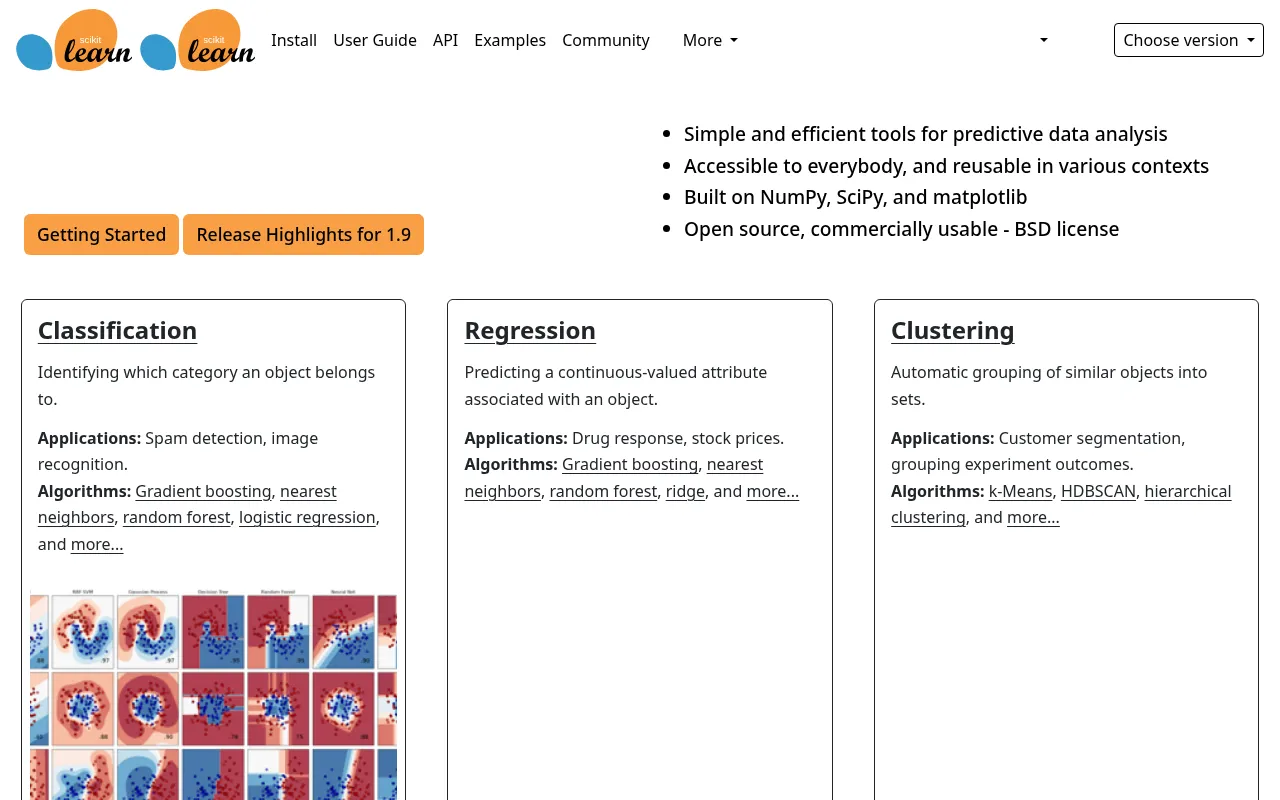
Scikit-learn is an open-source machine learning library for the Python programming language, designed to provide simple and efficient tools for data mining and data analysis.Built on top of fundamental scientific computing libraries like NumPy, SciPy, and matplotlib, it ensures robust compatibility in numerical computation and visualization.
The library covers the complete machine learning workflow, from data preprocessing and feature selection to model training and evaluation.Whether for classification, regression, or clustering tasks, Scikit-learn offers a consistent and user-friendly API, making it one of the most widely adopted standard tools in both academia and industry.
As a core component of the Python data science ecosystem, Scikit-learn emphasizes code readability and algorithmic practicality.It does not include deep learning capabilities but focuses on traditional statistical machine learning methods, providing developers with a stable, reliable, and well-documented development environment.
Key features
- Extensive AlgoriIncludes a wide variety of supervised (e.g., SVM, Random Forests, Gradient Boosting) and unsupervised (e.g., K-Means, PCA) learning algorithms to meet diverse modeling needs.
- Consistent API DAll estimators follow a uniform interface specification, making it extremely easy to switch between different algorithms and compare models.
- Robust PreprocesOffers rich data preprocessing capabilities, including standardization, normalization, missing value handling, and feature encoding, simplifying the data cleaning process.
- Model SelectionBuilt-in cross-validation, grid search, and various evaluation metrics help users systematically optimize hyperparameters and objectively assess model performance.
- Open Source & CoAs a BSD-licensed open-source project, it benefits from active community support and comprehensive official documentation, facilitating learning and troubleshooting.
How to use it
- 1.Ensure Python is installed, then install the library using the command pip install scikit-learn.
- 2.Load and clean your dataset using Pandas or NumPy, ensuring the data format meets model input requirements.
- 3.Select appropriate preprocessing methods (such as StandardScaler) to standardize your features.
- 4.Instantiate a machine learning model (e.g., LogisticRegression) and call the fit method to train it on your training data.
- 5.Use the predict method to make predictions on test data, and evaluate model performance using the score method or the metrics module.
Where it fits
- Customer Churn PBuild classification models using historical user behavior data to identify high-risk churn customers and assist in retention strategies.
- Housing Price AnAnalyze the relationship between housing features and prices using regression algorithms to predict market trends or specific property valuations.
- User SegmentatioApply clustering algorithms to group unlabeled user data, discovering potential market segments to optimize marketing campaigns.
Pricing and free quota
Pricing and any free quota follow the official site.
Who it is for
- Data Scientists
- Machine Learning Engineers
- Python Developers
- Statistical Analysts
FAQ
Is Scikit-learn suitable for deep learning?
No.Scikit-learn focuses on traditional machine learning algorithms.For deep learning tasks, frameworks like TensorFlow or PyTorch are recommended.
Do I need to pay to use Scikit-learn?
No.Scikit-learn is completely free and open-source, available for anyone to download and use without cost.
Can Scikit-learn handle large-scale data?
It is best suited for small to medium-sized datasets.For large-scale data that exceeds memory limits, it may need to be combined with distributed computing tools like Dask or Spark.